EN
 EN
 DA
 NL
 FI
 FR
 DE
 IT
 JA
 KO
 NO
 PL
 PT
 RO
 RU
 ES
 SV
 TL
 ID
 SK
 UK
 VI
 TH
 TR
 FA
 BE
 LA
 UZ
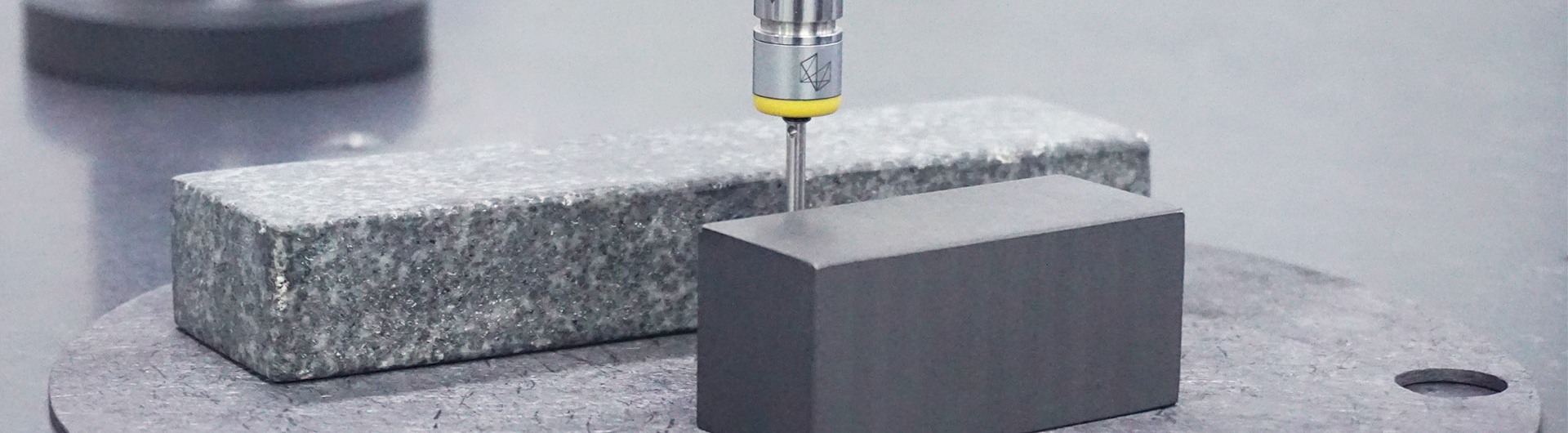
Pyrolytic Graphite (PG/PyC) and Glassy Carbon coatings both make porous graphite cleaner and less permeable, but they work differently. PG is a CVD-grown, strongly oriented carbon layer; Glassy Carbon is polymer-derived, non-graphitizing and more isotropic. This paper compares parameters, applications, failure modes, selection logic and RFQ requirements.
1. Pyrolytic Graphite Coating vs. Glassy Carbon Coating: Process Fundamentals
Core conclusion: PG and Glassy Carbon are not two grades of the same coating. PG/PyC is normally deposited from hydrocarbon gases by high-temperature CVD; Glassy Carbon is formed from a carbonizable polymer that is coated or impregnated, cured and carbonized. Their microstructures—and therefore their engineering behavior—are fundamentally different.
PG grows directly on graphite during CVD. The coating can be extremely dense and highly oriented, so thermal, electrical and expansion properties vary sharply by direction. Commercial PyC coatings reduce gas permeation, graphite-particle release and impurity emission.[2]
Glassy Carbon, more rigorously called glass-like carbon, is defined by IUPAC as agranular, non-graphitizable carbon with high isotropy and very low gas/liquid permeability.[1]
PG: hydrocarbon gas → CVD → oriented carbon layer
Glassy Carbon: polymer → coating/impregnation → curing → carbonization
2. PG vs. Glassy Carbon Coating: Key Parameters
Core conclusion: The decisive difference is not simply density or maximum temperature. PG combines a dense barrier with extreme directional thermal behavior; Glassy Carbon combines low open porosity with much more isotropic properties. On real parts, coating continuity, substrate quality and thermal cycling matter as much as bulk values.
| Parameter | PG / PyC | Glassy Carbon |
| Formation | Hydrocarbon CVD | Polymer + carbonization |
| Structure | Layered, oriented | Non-graphitizing, isotropic |
| Density | ~2.2 g/cm³ [2] | ~1.55 g/cm³* [4] |
| Thermal conductivity | 170–420 W/m`K parallel; 2–4 perpendicular [2] | ~6.2 W/m·K* [4] |
| CTE | 1.7 parallel; 28 perpendicular ×10⁻⁶/K [2] | ~2–3.4 ×10⁻⁶/K* [4] |
| Open porosity | Extremely low permeability | 0% for representative bulk grade* [4] |
| Main value | Dense CVD barrier; heat spreading | Pore sealing; low particles; wear resistance |
| Main risk | Stress, cracking, delamination | Shrinkage, pinholes, cracking |
*Bulk Glassy Carbon reference values; not guaranteed coating values.
Semixlab’s PG-coated crucible uses a typical 30–50 μm coating with ≤10 ppm impurity. For Glassy Carbon, thickness should be selected around precursor penetration, graphite grade, geometry and thermal cycling rather than copied from a bulk-material datasheet.
3. PG vs. Glassy Carbon Coating: Semiconductor Applications
Core conclusion: PG is usually the stronger starting point when a high-purity CVD carbon barrier and lateral heat spreading are required. Glassy Carbon becomes more attractive when graphite porosity, particle shedding, scratching or surface wear are the main problems. Final qualification should still be based on the actual reactor environment.
PG/PyC-coated graphite suits vacuum crucibles, rings, liners and selected silicon-processing hot-zone parts. It isolates open-pore graphite, suppresses dust and impurity release, and provides high in-plane thermal conductivity. Semixlab positions PG-coated crucibles for high-temperature vacuum evaporation and semiconductor processing.
Glassy-carbon-coated graphite is useful when a graphite body needs a cleaner, harder, lower-particle surface. Industry data for glass-like carbon treated graphite show application in silicon single-crystal pulling and epitaxial-growth parts, together with strong dust reduction and substantially improved scratch durability.[3]
A practical rule is:
Heat spreading + dense CVD barrier → evaluate PG first.
Pore sealing + particles + wear → evaluate Glassy Carbon first.
4. PG vs. Glassy Carbon Coating: Failure Mechanisms
Core conclusion: Most failures are coating–substrate system failures. PG is sensitive to CVD growth stress, anisotropic expansion and stress concentration. Glassy Carbon is sensitive to polymer-to-carbon shrinkage, incomplete sealing and thermal-cycle stress. In both cases, “more coating” does not automatically mean “more lifetime.”
PG
● Residual stress / edge cracking: corners, holes and thickness transitions concentrate stress during cooling.
● Delamination: poor surface preparation, unsuitable graphite, excessive thickness or repeated cycling can weaken the interface.
● Pinhole attack: vapor or melt reaching graphite through a defect can undermine the coating.
Engineering rule: use the minimum thickness that delivers barrier life without excessive interface stress.
Glassy Carbon
● Carbonization shrinkage: thick or rapidly heated precursor layers are more vulnerable to cracking.
● Incomplete sealing: poor penetration or unsuitable graphite pore structure can leave leak paths.
● Thermal-cycle peeling: chemical stability cannot compensate for poor CTE, adhesion or ramp-rate matching.
Engineering rule: precursor chemistry, infiltration depth, cure schedule and carbonization ramp are part of the coating specification.
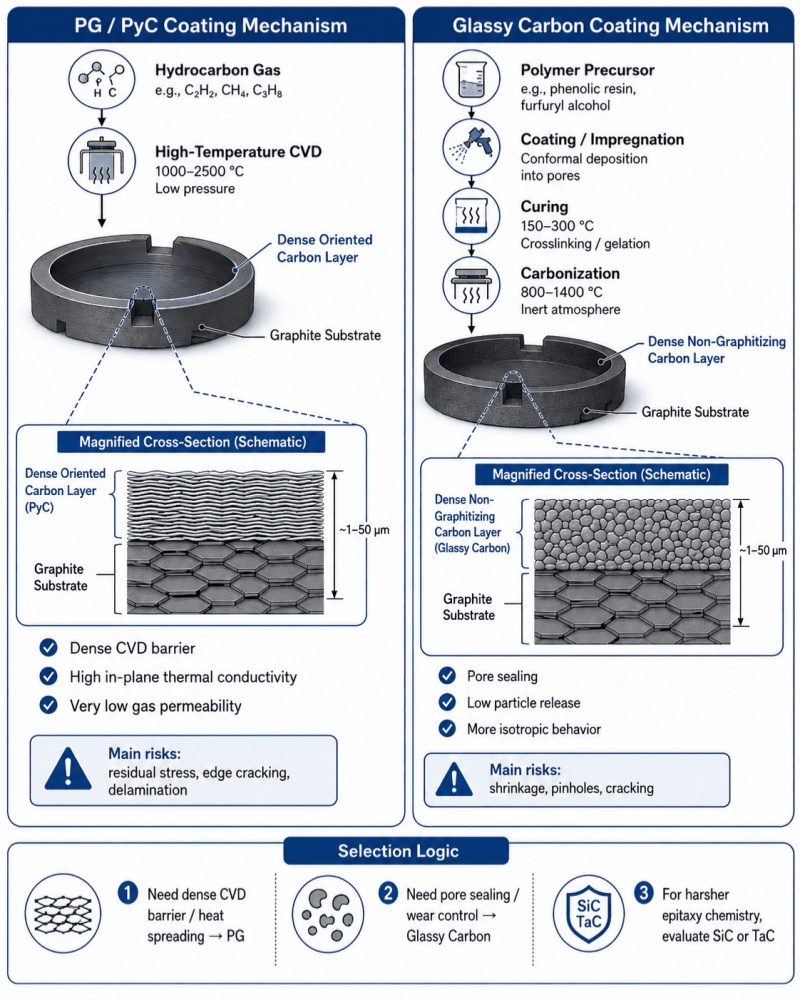
5. PG vs. Glassy Carbon Coating: Selection Decision Tree
Core conclusion: Start with the process problem, not the coating name. Atmosphere, contamination limits, heat-flow direction, graphite grade, geometry, reactive species and ramp rate should be screened before thickness. Maximum-temperature comparison alone is not a reliable semiconductor coating selection method.
High outgassing / gas penetration / high-purity carbon barrier?
→ PG/PyC
Graphite dust / abrasion / pore sealing?
→ Glassy Carbon
High lateral heat spreading?
→ PG
More isotropic surface behavior?
→ Glassy Carbon
Sharp edges, holes or thin sections?
→ Review thickness uniformity and stress.
Reactive vapor, melt or aggressive chemistry?
→ Run compatibility testing.
Preferred sequence:
Chemistry → Temperature → Contamination → Thermal Requirement → Graphite Grade → Geometry → Coating
6. When PG or Glassy Carbon Is Not Enough: SiC/TaC Boundary
Core conclusion: Carbon coatings should not be forced into every semiconductor hot zone. When oxidation resistance, aggressive precursor chemistry or severe SiC growth conditions dominate, the correct question may no longer be “PG or Glassy Carbon?” but whether a carbide coating is required.
CVD SiC is commonly used on graphite susceptors for Si/GaN epitaxy and MOCVD, while TaC is considered for harsher SiC crystal-growth or epitaxy hot zones. They are only boundary references here. If carbon-surface stability becomes the limiting factor, coating choice must be re-evaluated around reactor chemistry.
7. PG vs. Glassy Carbon Coating FAQ
Core conclusion: Search intent around this topic is practical: engineers want to know whether the materials are truly different, which seals graphite better, which handles heat better, why coatings crack and whether one can replace the other. Short, precise answers support both SEO and RFQ qualification.
1. Is pyrolytic graphite the same as pyrolytic carbon?
Not exactly. Pyrolytic carbon is broader; “pyrolytic graphite” usually implies stronger preferred orientation and anisotropy.
2. Is Glassy Carbon a type of graphite?
No. IUPAC classifies glass-like carbon as non-graphitizable carbon.[1]
3. Which provides better gas sealing?
Both can be excellent. PG relies on a dense CVD layer; Glassy Carbon on a low-permeability non-graphitizing structure. Pinholes and interface quality often decide real performance.
4. Which has better thermal conductivity?
PG by a wide margin along the coating plane: 170–420 W/m·K versus about 6.2 W/m·K for a representative bulk glass-like carbon grade.[2][4] PG is strongly directional.
5. Why does Glassy Carbon coating crack?
Usually because curing/carbonization shrinkage combines with excessive thickness, rapid heating, poor adhesion or unsuitable graphite porosity.
6. Can Glassy Carbon replace PG?
Sometimes, but not as a drop-in replacement. Choose PG for dense CVD carbon and heat spreading; choose Glassy Carbon for sealing, particle reduction and wear control.
References
[1] IUPAC Gold Book — Glass-like Carbon.
[2] Toyo Tanso — PYROGRAPH™ Pyrolytic Graphite Coating.
[3] Toyo Tanso — GLASTIX KOTE™ Glass-like Carbon Coated Graphite.
[4] Nisshinbo Chemical — Glass-like Carbon AC-140/AC-140S.
Table of Contents
- Pyrolytic Graphite Coating vs. Glassy Carbon Coating: Process Fundamentals
- PG vs. Glassy Carbon Coating: Key Parameters
- PG vs. Glassy Carbon Coating: Semiconductor Applications
- PG vs. Glassy Carbon Coating: Failure Mechanisms
- PG vs. Glassy Carbon Coating: Selection Decision Tree
- When PG or Glassy Carbon Is Not Enough: SiC/TaC Boundary
- PG vs. Glassy Carbon Coating FAQ
- References
Founded in 2018, Semixlab Technology Co.,Ltd is a technology-based enterprise focusing on the research and development, production and sales of advanced materials. It is a world-leading semiconductor material manufacturer.