EN
 EN
 DA
 NL
 FI
 FR
 DE
 IT
 JA
 KO
 NO
 PL
 PT
 RO
 RU
 ES
 SV
 TL
 ID
 SK
 UK
 VI
 TH
 TR
 FA
 BE
 LA
 UZ

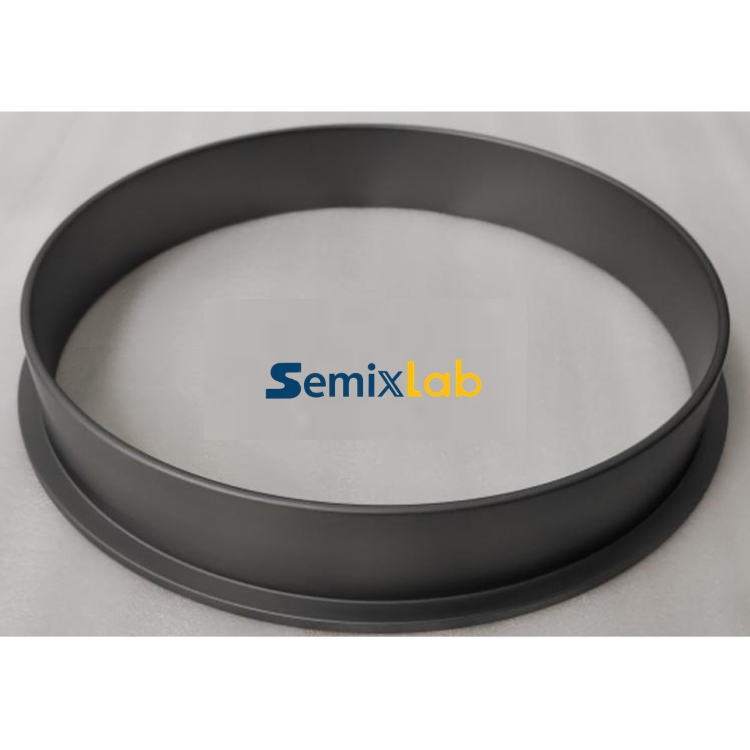
Pyrolytic Graphite (PG) Coating
Product Overview
Semixlab’s Pyrolytic Graphite (PG) coating is a highly oriented crystalline carbon material synthesized via high‑temperature Chemical Vapor Deposition (CVD) using hydrocarbon cracking. PG coatings exhibit exceptional thermal anisotropy: ultra‑high thermal conductivity along the a‑b planar orientation combined with thermal insulation along the c‑axis (z‑axis).
With high purity (total impurities < 5 ppm), zero gas permeability, and minimal outgassing, PG coating is an ideal choice for ion implantation, plasma etching, and heater protection components in semiconductor processing.
Key Features & Advantages
- Extreme Thermal Anisotropy: Delivers a‑b plane thermal conductivity of 350–450 W/(m·K) (comparable to pure copper) alongside z‑axis insulation at 3.5–5 W/(m·K), creating exceptionally uniform planar heat distribution.
- Impenetrable & Zero Porosity: Features a helium permeability < 10⁻¹¹ cm²/s, completely sealing porous graphite surfaces to prevent particle generation.
- High Chemical Inertness: Outstanding corrosion resistance against strong acids, bases, and molten salts (including fluorides).
- Self‑Lubricating & Non‑Flaking: Perfect crystalline graphite lattice provides a low coefficient of friction, high wear resistance, and zero metallic debris generation.
Technical Specifications
| Parameter | Standard / Value | Test Method / Condition |
|---|---|---|
| Carbon Content | ≥ 99.995% | Ash Content Analysis |
| Total Impurities | ≤ 5 ppm | GDMS / ICP‑MS |
| Density | 2.18 – 2.22 g/cm³ | Archimedes Principle |
| Thermal Cond. (a‑b axis) | 350 – 450 W/(m·K) | Laser Flash Method |
| Thermal Cond. (z axis) | 3.5 – 5.0 W/(m·K) | Laser Flash Method |
| Flexural Strength | ≥ 120 MPa (a‑b axis) | Three‑Point Bending |
| Helium Permeability | < 10⁻¹¹ cm²/s | Helium Mass Spectrometry |
Typical Applications
- Ion Implantation: Ion source chambers, target supports, aperture slits, and suppression electrodes designed to resist ion bombardment and reduce particle generation.
- CVD / PVD Heaters: Integrated PG/PBN wafer heaters providing uniform thermal profiles across large‑diameter wafers.
- Analytical Instruments: Protective internal coatings for graphite tubes used in Atomic Absorption Spectroscopy (AAS).
- Crystal Pulling: Thermal shielding and crucible shrouds for Czochralski (CZ) monocrystalline silicon growth furnaces.
Customization Capabilities
- Oriented Deposition Control: Precise control over PG crystal growth orientation on complex geometry parts based on specific heat flow requirements.
- Freestanding PG Components: Capability to produce freestanding pyrolytic graphite parts (several millimeters thick) and multi‑layer PG/PBN heaters.
- Micro‑Machining: Advanced CNC wire‑EDM and precision polishing capabilities allow for micro‑grooves and high‑precision hole features on PG surfaces.
Quality Assurance & Expertise
- Ultra‑Clean Post‑Processing: All PG‑coated components undergo high‑vacuum bake‑out (outgassing cleaning) and Class 100 cleanroom packaging prior to shipment.
- Trace‑Element Control: Rigorous monitoring of B, Fe, Ni, Cu, and Cr levels ensures zero cross‑contamination during ion implantation and thermal steps.
- Flexible OEM Support: Scalable manufacturing infrastructure capable of supporting rapid prototyping through to high‑volume commercial production.
Technical Resources & Next Steps
- Thermal Management Support: Contact Semixlab engineers for PG thermal performance modeling.
- Sample Evaluation: Request PG coated test coupons to verify ion bombardment performance.
- Download Resource: Download the Pyrolytic Graphite (PG) Technical Specification Guide (PDF)
Pyrolytic Graphite (PG) Coating
PyC coating is mostly used in SiC crystal growth systems, especially in PVT furnaces. It’s not really about pushing temperature limits, but more about improving how graphite parts behave over time.
The coating forms a relatively uniform layer on components like flow guide rings or insulation structures. This helps reduce gas penetration and limits carbon-related contamination, which can otherwise affect the growth environment.
In actual use, PyC-coated flow guide rings are probably the most common, but the same idea applies to support rings or thermal shields. For many users, the goal here is simple — keep the system stable over long cycles, rather than chasing higher temperature capability.