EN
 EN
 DA
 NL
 FI
 FR
 DE
 IT
 JA
 KO
 NO
 PL
 PT
 RO
 RU
 ES
 SV
 TL
 ID
 SK
 UK
 VI
 TH
 TR
 FA
 BE
 LA
 UZ
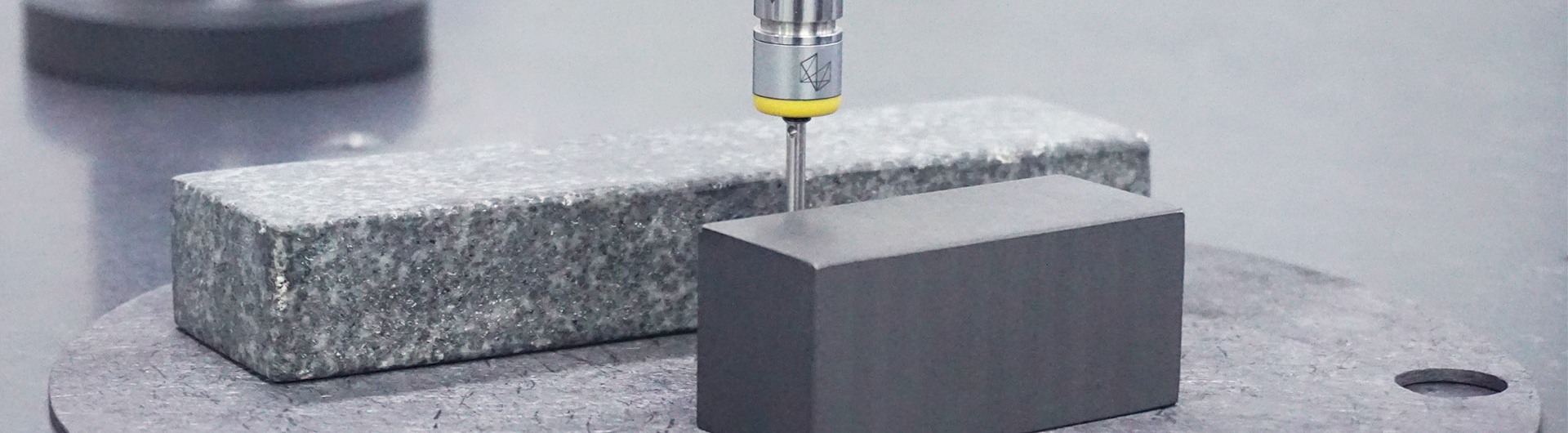
For PVT growth of SiC single crystals, the source is not merely a consumable. Purity, particle geometry, packing structure, thermal behavior, sublimation, and source evolution can affect vapor transport, utilization, growth rate, and crystal quality.
So, are CVD SiC blocks better than conventional SiC powder? Not universally. CVD-SiC blocks can offer tighter impurity control and a different source architecture, but their benefit depends on particle size, orientation, crucible geometry, temperature gradient, pressure, and hot-zone design. The real comparison is therefore source architecture versus process requirements.
1. Why Source Architecture Changes PVT Growth
In PVT growth, SiC source material is heated above 2000 °C and transported through the gas phase toward a cooler seed:
SiC Source → Sublimation → Vapor Transport → Seed → Crystal
Inside the crucible, however, the source bed continuously changes. High-temperature decomposition produces vapor species including Si, SiC₂, and Si₂C, while carbon-rich residue can develop [1]. Local temperature differences also drive sublimation and recrystallization.
Particle size, porosity, packing density, and internal channels therefore determine how heat and vapor move through the charge. Conventional powder creates many small interparticle pores. Large crushed CVD-SiC fragments can create fewer but much larger flow paths. At millimeter scale, the feedstock should be treated as a different PVT source architecture, not simply “coarse SiC powder.”
The coupling is direct:
Particle geometry → packing structure → local temperature → sublimation rate → vapor pathway → supersaturation at the growth front.
This is why two SiC sources with similar nominal purity can behave differently in the same reactor.
2. Conventional SiC Powder vs. CVD-SiC Blocks: What Actually Changes?
Conventional high-purity SiC powder remains the mature industrial choice. Most PVT crucibles, loading methods, thermal fields, and recipes were developed around granular sources.
Its limitation is that the powder bed evolves during growth. In-situ X-ray studies have shown that particle-size distribution and packing density affect sublimation–recrystallization behavior and growth-interface stability. Higher packing density with an optimized size distribution produced smoother source evolution and a more stable interface than less-dense powder configurations [2].
CVD-SiC feedstock behaves differently. Dense polycrystalline SiC produced by chemical vapor deposition can be crushed and size-classified into large fragments. These fragments usually have lower specific surface area than fine powder but can form macro-scale channels that change heat and mass transport.
| Factor | Conventional SiC Powder | Crushed CVD-SiC Blocks |
| Source form | Granular particles | Dense fragments / plates |
| Transport path | Micro-scale pores | Macro-channels can form |
| Packing | Statistical | Geometry/orientation dependent |
| Process maturity | High | Emerging |
| Main risk | Source evolution / flow resistance | Channeling / thermal nonuniformity |
A 2024 study found that large crushed CVD-SiC fragments formed macro-channels between blocks, and changing block arrangement changed channel direction [4]. Block orientation therefore becomes a process parameter. A favorable channel may accelerate mass transport, while poor arrangement can cause local depletion or nonuniform flow.
So, “larger particles are better” is not a reliable rule. The useful question is:
Does the source geometry create a stable thermal and vapor-transport field in the actual crucible?
3. Thermal Field and Growth Rate: Why CVD Blocks Can Enable Faster Growth
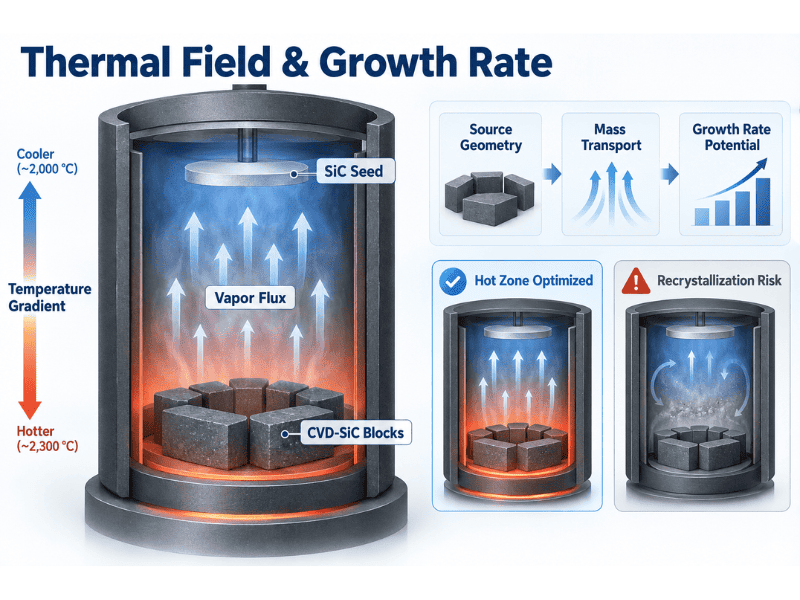
Growth rate is a major reason engineers are investigating CVD-SiC block sources. Increasing vapor supply to the seed can increase axial growth, but only if the growth front can accept that flux without polycrystalline deposition, inclusions, or interface instability.
A 2024 CrystEngComm study used recycled CVD-SiC blocks as PVT source material and reported 1.46 mm/h growth. The blocks were not used as a simple drop-in replacement: multiphysics simulation was used to configure a hot zone with a larger temperature gradient. The study reported about 3.8 °C/mm near the growth front at approximately 2268 °C [3].
This is important because it separates two variables that are often incorrectly combined:
Source capability determines how material is made available.
Thermal-field design determines how efficiently that material is transported and deposited at the seed.
A second 2024 study showed that large crushed CVD-SiC blocks generated stronger source-region temperature gradients than conventional powder and that vertically aligned blocks could support rapid growth. It also showed the opposite risk: unfavorable cold regions can cause premature recrystallization before vapor reaches the seed.
The correct conclusion is:
CVD-SiC feedstock can support high-rate PVT growth, but growth rate is a system property—not a guaranteed property of the feedstock.
This distinction is especially important when comparing suppliers. A published growth-rate value cannot replace qualification in the customer's actual crucible diameter, source-to-seed distance, pressure range, insulation structure, and temperature field.
Recent powder-source research supports the same system view. A 2026 study found that non-uniform source consumption and recrystallization disturbed thermal and flow fields. An optimized porous graphite plate increased source utilization by 29%, growth rate by 33%, and reduced defect density by 52% in the studied configuration [5].
The broader engineering lesson is clear:
SiC source material + graphite structure + thermal field + mass transport must be optimized as one coupled system.
4. Purity and Crystal Quality: Advantage Without Overclaiming
High purity is an important reason to evaluate CVD SiC feedstock. CVD synthesis from purified gaseous precursors allows tighter control of impurity incorporation during deposition.
But a headline “6N” or “7N” value is not enough for technical qualification. Engineers should ask for an impurity budget, including:
● total metallic impurities;
● N, B, Al, Fe, Ti, V and other critical elements;
● oxygen or residual process contaminants where relevant;
● free Si and free C;
● analytical method and detection limit;
● lot-to-lot variation.
This matters because two materials described by the same nominal purity grade may contain very different impurity species. For semi-insulating or tightly controlled electrical properties, the identity of the residual impurities may be more important than the total purity number alone.
CVD processing is also not automatically contamination-free after deposition. Crushing, classification, cleaning, handling, and packaging can introduce contamination. The finished CVD SiC feedstock supplied to the PVT user should therefore be analyzed—not only the original CVD body.
The same caution applies to crystal defects.
Higher-purity source material can remove one source of variability, but micropipes, threading dislocations, basal-plane dislocations, polytype instability, carbon inclusions, and thermal stress also depend on:
seed quality + temperature gradients + interface shape + supersaturation + hot-zone contamination + pressure + growth rate.
The 1.46 mm/h CVD-block experiment demonstrated that rapid growth with useful crystal quality is technically possible, but it does not prove that CVD blocks universally reduce defects.
The technically defensible conclusion is:
High-purity CVD-SiC feedstock improves control over source-side impurity and transport variables; final crystal quality still depends on the complete PVT process.
This distinction is essential for both E-E-A-T credibility and realistic supplier evaluation.
5. How Should Engineers Choose and Qualify the Source?
Conventional SiC powder is generally the lower-risk option when process maturity, minimal recipe change, established historical data, and straightforward supplier comparison are priorities.
CVD-SiC blocks become attractive when the objective is:
●l tighter impurity control;
● engineered source geometry;
● high-rate PVT development;
● semi-insulating crystal growth;
● improved source transport;
● source–thermal-field co-optimization.
Qualification should compare measurable KPIs rather than one successful boule.
| Qualification Area | Recommended KPI |
| Incoming material | Purity, impurities, particle-size distribution |
| Loading | kg/crucible, packed density, block orientation |
| Growth | Axial rate and interface shape |
| Source evolution | Consumption, recrystallization, residual morphology |
| Utilization | Source-to-crystal mass conversion |
| Crystal quality | Polytype, MP/TSD/TED/BPD, inclusions, resistivity |
| Repeatability | Multiple runs and multiple lots |
A strong DOE should separate material effect from recipe effect.
If source material, pressure, heater power, and hot-zone geometry are all changed together, improved crystal performance cannot be attributed to the feedstock alone.
For Semixlab CVD SiC crystal growth raw material, the listed 4–10 mm specification should therefore be treated as a qualification input, not a universal optimum [6].
The better commercial question is not simply:
“What is the price per kilogram?”
It is:
“What impurity profile, particle distribution, packed loading, source utilization, and reproducible crystal performance can this feedstock deliver in our PVT system?”
A practical qualification route is:
Powder Baseline → CVD-SiC Feedstock DOE → Thermal-Field Optimization → Multi-Run Qualification → Production Release
This approach turns a raw-material comparison into an engineering decision.
6. Technical FAQ
1. Can CVD SiC blocks directly replace conventional SiC powder?
They can be used as PVT source material, but direct recipe transfer should not be assumed. Large fragments change packing structure, effective thermal behavior, and vapor pathways, so the hot zone and growth recipe may require requalification.
2. Does CVD-SiC feedstock increase PVT growth rate?
It can. Peer-reviewed research demonstrated 1.46 mm/h growth using CVD-SiC block sources, but the result depended on a specifically designed thermal field. Growth rate must therefore be validated in the target PVT reactor.
3. What particle size is best for CVD SiC feedstock?
There is no universal optimum. Particle size should be matched to crucible geometry, source height, packing structure, thermal gradient, and vapor-transport requirements.
4. What data should be requested from a CVD SiC source supplier?
Request particle-size distribution, representative COA, element-specific impurity data, analytical methods and detection limits, lot-to-lot consistency, and sufficient material for multi-run qualification.
5. When is CVD-SiC feedstock most worth evaluating?
It is particularly relevant for high-rate PVT development, tighter impurity control, semi-insulating crystal programs, engineered source transport, and projects where the source material and graphite hot zone can be optimized together.
References
[1] Wellmann, P. J.
“Review of SiC crystal growth technology.”Semiconductor Science and Technology.
[2] Ellefsen, O. M.; Arzig, M.; Steiner, J.; Wellmann, P.; Runde, P.
“Optimization of the SiC Powder Source Material for Improved Process Conditions During PVT Growth of SiC Boules.
[3] Jeong, S.-M.; Kim, Y.-H.; Sun, J.-H.; Park, J.-H.; Shin, Y.-J.; Bae, S.-Y.; Kim, C.-M.; Lee, W.-J.
“Rapid growth of SiC single crystals using CVD-SiC block sources via a sublimation method.”
[4] Sun, J.-H.; Park, J.-H.; Bae, S.-Y.; Shin, Y.-J.; Kwon, Y.-J.; Lee, W.-J.; Kwon, S.-H.; Jeong, S.-M.
“Growths of SiC Single Crystals Using the Physical Vapor Transport Method with Crushed CVD-SiC Blocks Under High Vertical Temperature Gradients.”
[5] Chen, Y.; Ye, X.; Liu, S.; Kang, W.; Jiang, W.; Yin, J.; Kang, J.
“Porous graphite plate design in SiC PVT growth: optimized powder source evolution for enhanced crystal yield and quality.”
Table of Contents
- Why Source Architecture Changes PVT Growth
- Conventional SiC Powder vs. CVD-SiC Blocks: What Actually Changes?
- Thermal Field and Growth Rate: Why CVD Blocks Can Enable Faster Growth
- Purity and Crystal Quality: Advantage Without Overclaiming
- How Should Engineers Choose and Qualify the Source?
- Technical FAQ
Founded in 2018, Semixlab Technology Co.,Ltd is a technology-based enterprise focusing on the research and development, production and sales of advanced materials. It is a world-leading semiconductor material manufacturer.