EN
 EN
 DA
 NL
 FI
 FR
 DE
 IT
 JA
 KO
 NO
 PL
 PT
 RO
 RU
 ES
 SV
 TL
 ID
 SK
 UK
 VI
 TH
 TR
 FA
 BE
 LA
 UZ

Glass Carbon Coating
Product Overview
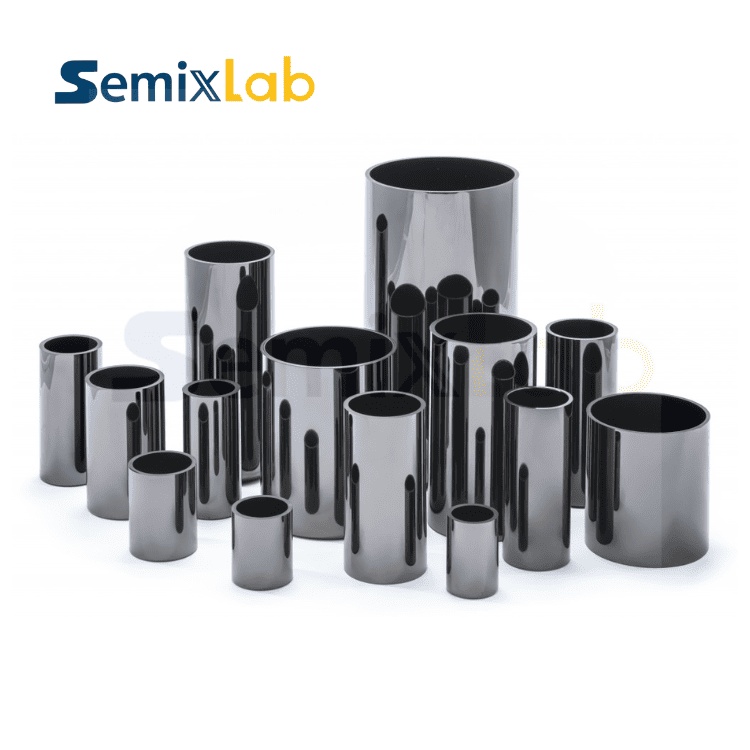
Semixlab’s Glass Carbon Coating (also known as Glassy or Vitreous Carbon coating) is an amorphous carbon material that combines the impermeable surface characteristics of glass with the chemical inertness of isotropic graphite. Produced through controlled pyrolysis of polymeric precursors in a inert atmosphere, this coating features a smooth, impervious surface with zero particle shedding, high mechanical hardness, and isotropic thermal expansion. It provides an effective barrier against graphite degradation and chemical attack in wet chemical processing, plasma etching, and molten silicon/metal handling.
Key Features & Advantages
- Non‑Porous Mirror Finish & Zero Particles: Completely free of grain boundaries with a smooth, glass‑like surface (sub‑micron Ra), eliminating graphite flaking and particle shedding caused by mechanical friction or gas erosion.
- Isotropic Structure & Thermal Stability: Displays fully isotropic physical and thermal properties, maintaining structural integrity up to 2000°C in non‑oxidizing atmospheres without phase changes.
- Resistance to Corrosives & Molten Metals: Highly inert to hydrofluoric acid (HF), nitric acid (HNO₃), aqua regia, and non‑wetting to molten silicon and germanium.
- Superior Gas Impermeability: Gas permeability is 5 to 6 orders of magnitude lower than standard isostatic graphite, effectively sealing out trace gas absorption and outgassing.
Technical Specifications
| Parameter | Standard / Value | Test Method / Condition |
|---|---|---|
| Material Phase | Amorphous Glassy Carbon | XRD Diffuse Halo Detection |
| Purity | Ash Content < 10 ppm (High‑purity grade < 2 ppm) | Spectrophotometry |
| Density | 1.45 – 1.55 g/cm³ | Archimedes Principle |
| Mohs Hardness | 6 – 7 (Similar to quartz glass) | Micro‑indentation |
| Gas Permeability | 10⁻⁹ – 10⁻¹² cm²/s | Helium Leak Testing |
| Electrical Resistivity | 40 – 50 µΩ·m | Four‑Point Probe |
| Surface Roughness | Ra ≤ 0.4 µm (As‑deposited) | Surface Profilometer |
Typical Applications
- Wet Etch & Clean Equipment: Wafer carriers, wet processing cassettes, and chemical delivery components exposed to concentrated HF/HNO₃ acids.
- Molten Silicon & Metal Contact Parts: Silicon melting crucible components, CZ puller sensor protective sleeves, and non‑wetting liquid metal guide tubes.
- Plasma Etch Components: Focus rings and edge rings requiring zero particle generation to minimize wafer defect counts.
- Analytical & Electrochemical Electrodes: High‑purity analytical electrodes and substrate plates for electrochemical applications.
Customization Capabilities
- Uniform Encapsulation: Polymer‑precursor crosslinking processes ensure complete, seamless coating coverage over complex geometries, inner pipe walls, and micro‑apertures.
- Multi‑Layer Architectures: Capable of producing multi‑layer composite coatings (e.g., Glassy Carbon sealing layer combined with CVD SiC or PG topcoats) for multi‑variable process environments.
- Surface Morphology Control: Surface finishes can be tailored from mirror‑like (Ra < 0.1 µm) to micro‑textured finishes based on specific chemical or electro‑analytical needs.
Quality Assurance & Expertise
- Rigorous Quality Control: Every production batch undergoes 100% inspection for micro‑cracks, helium leak rates, and trace ash content.
- Contamination‑Free Environment: Precursor pyrolysis and coating processes are performed in cleanroom environments to guarantee freedom from trace metal contamination.
- Fab‑Proven Solutions: Widely adopted by semiconductor wet‑end equipment OEMs and front‑end fabs for part life extension and second‑sourcing initiatives.
Technical Resources & Next Steps
- Reduce Particle Defects: Consult with our engineers to discuss Glassy Carbon replacement solutions.
- Request Samples & Quotes: Submit your part dimensions and process requirements for a rapid quotation.
- Download Resource: Download the Glass Carbon Coating Technical Datasheet (PDF)
Glass Carbon Coating
Glassy carbon coating is typically used when cleanliness becomes more critical than anything else. It creates a smoother and more inert surface on graphite, which helps reduce particle generation during operation.
You’ll see it in applications like silicon crystal growth, epitaxy, or MOCVD susceptors. In some cases, it’s also used outside semiconductors, for example in metallurgical tooling.
One interesting use case is in MBE systems. Because of its higher electrical resistivity, it can help certain components reach operating temperature more efficiently, sometimes without the need for additional cooling. It’s not the most common coating, but in specific environments — especially where contamination control is tight — it can be a practical option.