EN
 EN
 DA
 NL
 FI
 FR
 DE
 IT
 JA
 KO
 NO
 PL
 PT
 RO
 RU
 ES
 SV
 TL
 ID
 SK
 UK
 VI
 TH
 TR
 FA
 BE
 LA
 UZ
Abstract
Particle size alone does not determine whether a SiC PVT source will perform well. This article explains how particle-size distribution, packing density, porosity and source geometry interact with heat transfer, sublimation, recrystallization and vapor transport. It compares fine, coarse and bimodal SiC powders with millimeter-scale CVD-SiC blocks and provides a practical framework for qualifying source materials in real PVT systems.
In physical vapor transport (PVT) growth of SiC single crystals, source particle size is not simply a purchasing specification. It helps determine how the source packs, how much SiC can be loaded into the crucible, how vapor moves through the source bed, and how the source evolves during a long growth cycle.
So, what is the best SiC particle size for PVT crystal growth?
There is no universal optimum.
The most suitable source depends on the interaction among particle size distribution, morphology, packing density, porosity, thermal field, pressure, crucible geometry and target growth rate.
A useful engineering relationship is:
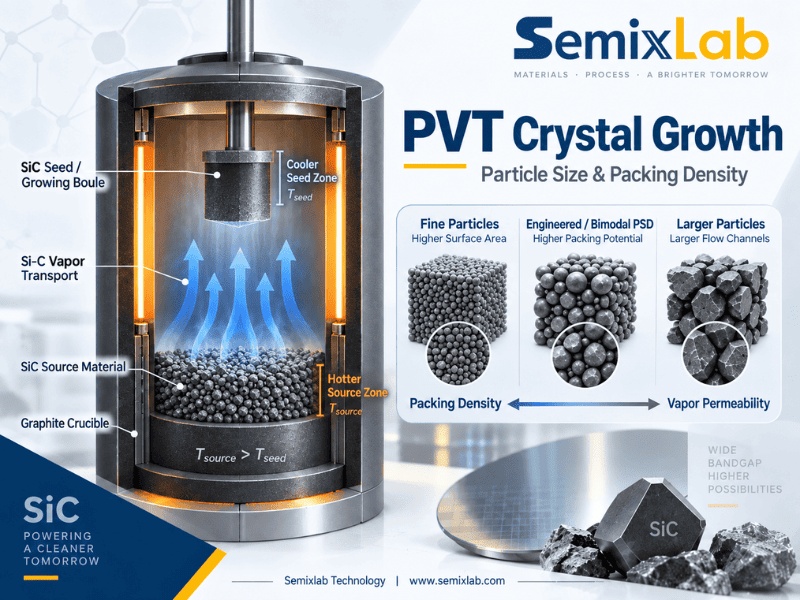
Particle Size → Packing Structure → Heat & Mass Transport → Sublimation / Recrystallization → Source Stability → Crystal Growth
Research using in-situ X-ray visualization has shown that both particle-size distribution and packing density can significantly affect source consumption and growth-interface stability.
1. Why Particle Size Matters in PVT Growth
A PVT source is a porous medium rather than a solid reservoir.
During growth, SiC sublimates from hot source regions, vapor species travel through pores and channels, and some material may recrystallize in cooler regions before reaching the seed.
Particle size influences several competing mechanisms:
| Source Property | Effect of Particle Size |
| Specific surface area | Smaller particles generally provide more surface |
| Packing density | Depends strongly on size distribution |
| Porosity | Controls internal vapor pathways |
| Gas-flow resistance | Usually increases as channels become smaller |
| Thermal conductivity | Changes with particle contacts and porosity |
| Source consumption | Depends on local temperature and surface area |
| Recrystallization | Influenced by thermal and transport gradients |
Fine particles can provide a large sublimation area, but a tightly packed fine-powder bed can also create small flow channels and greater vapor-transport resistance.
Larger particles provide lower specific surface area but usually create wider pathways.
Therefore:
More surface area does not automatically mean better PVT performance.
The important question is whether the source maintains a stable balance between sublimation capability and vapor transport throughout the growth run.
2. Particle Size Distribution vs. Packing Density
Mean particle size alone does not describe a PVT source adequately.
Two powders with the same average diameter can behave differently if one has a narrow distribution and the other contains a mixture of coarse and fine particles.
Packing density matters because it determines how much source can be loaded into a fixed crucible volume and how the internal pore network is formed.
In a 2019 study, a high-purity SiC powder with an average particle diameter of approximately 324 µm and loose packing density around 1.6 g/cm³ showed favorable source evolution during PVT growth. The researchers associated relatively large particles, narrow size distribution and high packing density with improved stability.
Another study compared monomodal and bimodal SiC powder sources. Monomodal sources with D90 values around 50 and 200 µm showed an average powder density near 1.17 g/cm³, while a bimodal mixture reached approximately 1.66 g/cm³ and exhibited smoother morphology change and more stable interface evolution.
This does not mean that 300 µm or 1.6 g/cm³ is universally optimal.
It demonstrates a more important principle:
Particle-size distribution can be engineered to increase packing density without simply reducing every particle to a smaller size.
3. How Source Structure Controls Heat and Vapor Transport
Packing density and porosity affect both thermal and mass transport.
A powder bed with many particle contacts may conduct heat differently from a loosely packed bed. At the same time, the pore network determines how easily Si-containing and C-containing vapor species move toward the seed.
During long PVT runs, this structure does not remain constant.
Source particles are progressively consumed, while vapor may recrystallize in lower-temperature regions. As a result:
Porosity changes → local heat transfer changes → vapor pathways change → source consumption becomes less uniform.
A recent study of powder-source evolution found that nonuniform consumption and recrystallization disturbed both thermal and flow fields, reducing source utilization. In that specific 150 mm PVT configuration, redesigning the porous graphite plate improved source utilization by 29% and growth rate by 33%.
The important conclusion is not that a porous plate produces the same gain in every furnace.
It is that:
Source packing and the surrounding graphite structure form one coupled heat-and-mass-transfer system.
For this reason, particle size should never be specified independently of crucible and hot-zone design.
4. Fine Powder vs. Coarse Powder vs. Bimodal Sources
Each source architecture has potential advantages and limitations.
Fine SiC Powder
Potential advantages:
· high surface area;
· rapid local sublimation;
· easy crucible filling.
Potential limitations:
· small vapor channels;
· higher transport resistance;
· greater sensitivity to morphology evolution;
· possible carbon-dust generation depending on powder quality.
Coarse SiC Powder
Potential advantages:
· larger interparticle channels;
· potentially more stable source morphology;
· reduced specific surface area.
Potential limitations:
· lower packing density if particle distribution is poorly designed;
· fewer contact points;
· possible nonuniform thermal behavior.
Bimodal Particle Distribution
A controlled combination of coarse and fine particles can allow smaller particles to fill voids between larger grains.
This can increase:
kg of source per crucible → packing density → potential boule length
while maintaining useful transport pathways.
Experimental X-ray studies found that a bimodal source showed smoother source morphology evolution than the tested single-modal sources.
But higher packing density is not automatically better.
If small particles fill too much of the available pore space, permeability may decline.
The engineering target is therefore:
High loading density with sufficient and stable vapor permeability.
5. What Changes at CVD-SiC Block Scale?
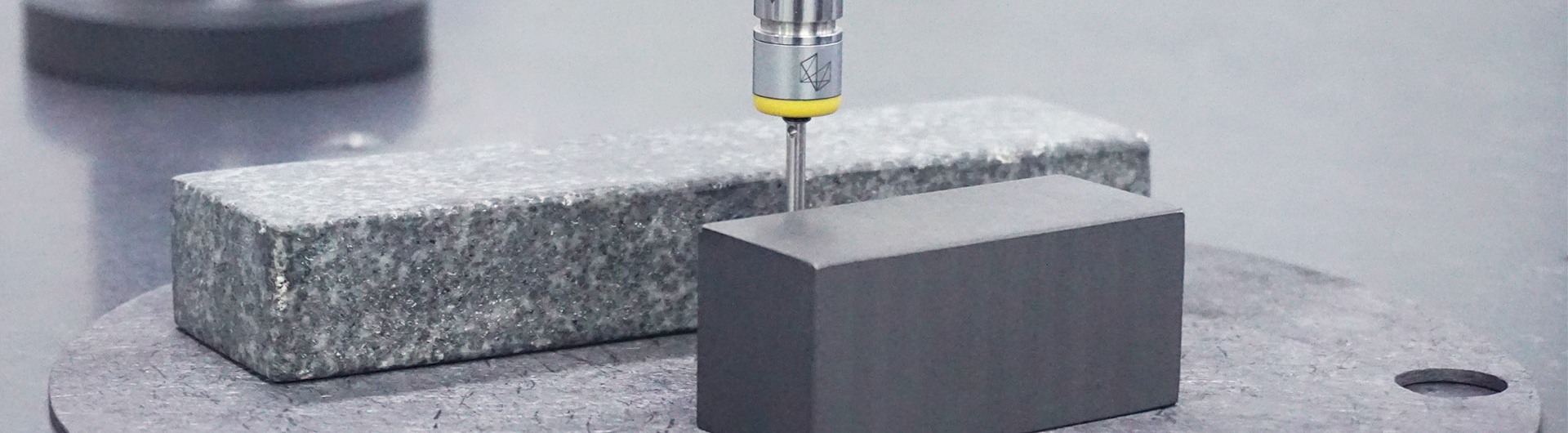
When source dimensions increase from hundreds of micrometers to millimeter-scale CVD-SiC blocks, the transport mechanism begins to change.
Instead of a conventional granular porous bed, large fragments can form distinct macrochannels.
A 2024 study using crushed CVD-SiC blocks found that larger plate-like fragments created large pathways between blocks, and changing block orientation changed the direction of these channels.
This introduces new engineering variables:
· block thickness;
· aspect ratio;
· orientation;
· void size;
· source height;
· contact area;
· radial arrangement.
Recent experiments have also demonstrated rapid PVT growth using CVD-SiC block sources, including a reported 1.46 mm/h growth rate in a specifically optimized experimental configuration.
However:
Large source particles do not inherently guarantee higher growth rate.
Macrochannels may improve vapor transport, but excessive void volume or unfavorable orientation can create thermal nonuniformity, local depletion or premature recrystallization.
At this scale, the relevant parameter is no longer only “particle size.”
It becomes: Source Geometry
6. How Should Engineers Select and Qualify Particle Size?
A practical source-selection program should not start with:
“What particle size should we buy?”
It should start with:
“What source structure gives stable transport in our PVT reactor?”
Recommended qualification parameters include:
| Category | Parameter |
| Particle specification | D10 / D50 / D90 or controlled size range |
| Morphology | Shape, roundness, aspect ratio |
| Packing | Loose and actual crucible packing density |
| Porosity | Effective void fraction |
| Loading | kg source per crucible |
| Source evolution | Consumption and recrystallization pattern |
| Growth | Axial rate and interface stability |
| Utilization | Source-to-crystal conversion |
| Repeatability | Multiple lots and growth runs |
For conventional powder, a DOE may compare:
Fine → Coarse → Bimodal PSD
For CVD-SiC feedstock:
Block Size → Block Orientation → Packing Arrangement
The most meaningful test is not the incoming particle-size certificate alone.
It is whether the source produces repeatable:
thermal behavior + source consumption + vapor transport + crystal growth
across multiple runs.
For Semixlab's CVD SiC crystal-growth raw material, a millimeter-scale size range should therefore be treated as a starting parameter for reactor qualification, not as a universal optimum.
7. Technical FAQ
1. What is the best SiC particle size for PVT crystal growth?
There is no universal best size. The optimum depends on crucible geometry, thermal field, pressure, packing density, source height and growth target.
2. Does larger SiC particle size improve PVT growth?
Larger particles can provide wider vapor pathways and more stable source morphology, but excessive size or void volume may reduce packing density or create thermal nonuniformity.
3. Why is packing density important?
Higher packing density allows more source mass in a fixed crucible volume and may support longer growth runs, but permeability must remain sufficient for stable vapor transport.
4. Is bimodal SiC powder better than monomodal powder?
Published experiments have shown smoother source evolution and higher packing density for certain bimodal distributions, but the result is system-specific and should be validated in the actual PVT reactor.
5. How are CVD-SiC blocks different from coarse powder?
At millimeter-scale dimensions, large CVD-SiC fragments can form macrochannels whose orientation and geometry directly affect vapor transport. They should be treated as an engineered source architecture rather than simply coarse powder.
6. What should be included in an RFQ for SiC source material?
particle-size distribution or controlled range; particle morphology; purity and impurity data; packing/bulk density; lot consistency; sample quantity; and enough material for multi-run qualification.
For CVD-SiC blocks, also specify:
crucible dimensions + target charge mass + preferred block range + growth objective.
References
1. Ellefsen, O. M.; Arzig, M.; Steiner, J.; Wellmann, P.; Runde, P.
“Optimization of the SiC Powder Source Material for Improved Process Conditions During PVT Growth of SiC Boules.”
2. Steiner, J.; Arzig, M.; Hsiao, T. C.; Wellmann, P.
“Optimization of the SiC Powder Source Size Distribution for the Sublimation Growth of Long Crystals Boules.”
3. Sun, J.-H. et al.
“Growths of SiC Single Crystals Using the Physical Vapor Transport Method with Crushed CVD-SiC Blocks Under High Vertical Temperature Gradients.”
4. Jeong, S.-M. et al.
“Rapid Growth of SiC Single Crystals Using CVD-SiC Block Sources via a Sublimation Method.”
Table of Contents
- Why Particle Size Matters in PVT Growth
- Particle Size Distribution vs. Packing Density
- How Source Structure Controls Heat and Vapor Transport
- Fine Powder vs. Coarse Powder vs. Bimodal Sources
- What Changes at CVD-SiC Block Scale?
- How Should Engineers Select and Qualify Particle Size?
- Technical FAQ
- What is the best SiC particle size for PVT crystal growth?
- Does larger SiC particle size improve PVT growth?
- Why is packing density important?
- Is bimodal SiC powder better than monomodal powder?
- How are CVD-SiC blocks different from coarse powder?
- What should be included in an RFQ for SiC source material?
Founded in 2018, Semixlab Technology Co.,Ltd is a technology-based enterprise focusing on the research and development, production and sales of advanced materials. It is a world-leading semiconductor material manufacturer.